
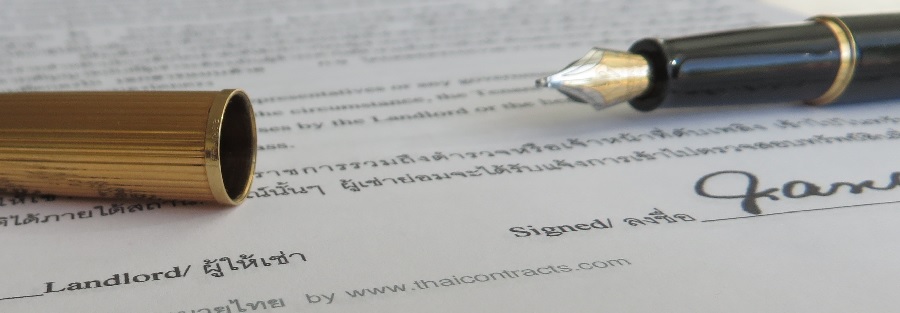
Whether the contract is called rental, tenancy, lease or leasehold such agreements in Thailand are governed by the civil and commercial code, chapter 'rent of property'. Any agreement whereby the owner of a property agrees to let another person have the use of the property for a limited period of time and the other party agrees to pay rent must be read as a rent of property contract between a tenant and a lessor.
Common questions and answers:
tenancy (lease and rental agreements)
- Where to find laws governing leases by foreigners?
- Does the lease need to be registered with the Land Department?
- What to check before leasing a real estate in Thailand?
- Does a lease need to have a rental price?
- Can I, as a form of protection, lease real estate from my (Thai) wife?
- Is it safer to lease from a developer?
- Can the lessee and lessor execute 2 consecutive 30 year lease agreements?
- What are the formal requirements for lease of property in Thailand?
- Are there any property taxes when renting/ leasing property?
- When leasing real estate, can I own the structure on the land?
- Can I enter into a 90-year land lease agreement?
- Can I lease from my company?
- Does transfer of ownership of the land affect my lease rights?
- Does a lease in Thailand end when the lessee (tenant) dies?
- Can a lease be extended beyond 30 years through renewal options?
- Can a sublet my rented house in Thailand while I'm overseas?
- Can I sell my long term lease?
- What is key money in a tenancy?
- Is an office rent with a term of 3 + 2 years enforceable for the term of 5 years?
- Are 3 consecutive back-to-back 3 year leases enforceable for the total of 9 years?
Where to find laws governing property lease by foreigners in Thailand?
Lease or tenancy by foreigners is governed by the civil and commercial code and specifically the sections rent of property. Only in case of specific foreign commercial rentals the lease could in addition be governed by the 'Lease of Immovable Property for Commerce and Industry by Foreigners Act B.E. 2542', but only following specific conditions and requirements, such as very substantial foreign investments, have been met. There is no specific law for the lease of property for residential purposes by foreigners, but there are certain land office regulations governing the content of long term real estate or land lease agreements by foreigners (basically the lease cannot be in conflict with foreign land ownership restrictions or contain prepaid 30-year renewal options.
Does the lease need to be registered with the Land Department?
Any lease exceeding the term of 3 years must be in writing and needs to be registered with the Land Department to be enforceable for the term exceeding 3-years (section 538). The lease will be noted on the backside of the title deed of the owner and on the original land title deed as held by the Land Office. There will also be an official one page land lease document in Thai (with the government’s Guaruda symbol) that parties need to sign with the basic details of the private lease agreement between the parties. This Thai land office document must refer to the private lease agreement between the parties. At the Land Office everything is done in Thai, even your name is usually written in Thai script.
If you are married it is recommended in a long term lease structure to have both spouses registered as the lessee, you could also name children (if any) in the contract under lessee who can each remain as the lessee if the event of death of one or more of the lessees.
What to check before leasing a real estate in Thailand?
First of all the property must be suitable for the purpose you want to lease it for and the lease structure should be verified, the lease agreement should contain the necessary terms and conditions should be agreed upon, the lessor must be allowed to lease the property to you as the lessee AND as with buying property the land or real estate property must have an unencumbered legal title deed and other practicals related to the property (like access to a public road) should be checked, see basic checklist....
Does a lease need to have a rental price?
A lease without a rental price would not be a lease but considered a right of habitation. For tax and lease registration purposes the lease must include a reasonable rent, when the rental price is to low, the rental/ lease price could be adjusted by the government following a calculation method based on the type of building, number of floors and appraised value or government assessed value of the property.
Can I, as a form of protection, lease real estate from my (Thai) wife?
If it would be registered by the Land Department, any agreements (like lease agreement) between husband and wife can be voided by either party pursuant to section 1496 civil and commercial code, therefore does not offer protection. In a divorce, when during the marriage property is bought from your personal assets or marital assets and registered as a personal property of your wife, such investments can be voided (section 1469) and the return of the money in such case shall be governed by the provisions on 'Undue Enrichment' (and is based on what you can prove).
Is it safer to lease from a developer?
In an official licensed housing development the property itself should be legally safe, however, as for the lease structure, consumer protection laws do not apply (as opposed to sale and purchase agreements). The rule with residential leasehold housing and apartment project in Thailand's is to read all contracts involved (supplemental contracts) in detail. A private development could aso be safe, but also many things could be wrong (the legal structure, development permission, land titles, building permits, access, etc.). Let the buyer beware.
Can the lessee and lessor execute 2 consecutive 30 year lease agreements?
When the leaseholder (lessee) and freeholder (lessor) have executed 2 consecutive 30-year lease agreements (whether registered with the land office or not) it shall by law and supreme court rulings be deemed as one lease. The second lease contract shall be deemed void (section 150 civil code) or if considered as one lease reduced to a 30 year term (section 544 civil code).
What are the formal requirements for lease of property in Thailand?
A lease is governed by the civil and commercial code and as a contract governed by general Thai contract laws and the chapter specific contracts under the title 'rent of property'. A rent or lease is enforceable by legal action if it has written evidence. When the lease is made for a period exceeding 3 years it has to be registered with the land office on the land title deed (section 538). In addition a long term lease must comply with land office regulations (it may for example not include pre-paid 30 year renewal terms or through its terms suggest foreign land ownership).
Are there any property taxes when renting/ leasing property?
There is a property tax collected at the rate of 12.5% over the yearly rental or assessed rent price when a building/ apartment is leased. This tax is governed by the Land and House tax Act B.E. 2475. Income from renting out a property is governed by the section 'personal income tax' in the revenue code. When the lease must be registered there is also a lease registration fee of 1% and a stamp duty of 0.1% over the total rental throughout the lease term, charged by the land office upon registration.
When leasing real estate, can I own the structure on the land?
In any long term interest in a real estate property by foreigners it is recommended to separate ownership of land and the building on the land. Separate ownership is obtained by a land lease including provision for the use of the land for building and/or by a right of superficies. In case of an existing building the building ownership must be transferred in a separate sale of a structure procedure at the land office.
Can I enter into a 90-year land lease agreement?
The maximum lease term in Thailand is 30 years. This term can be renewed, but this will be a new lease and there is no guarantee the lease will be renewed. The 90 year lease agreement (3 x 30 years) includes prepaid renewal options and rights to transfer the property to a freehold title. Currently such leases are considered void and registration will be refused by the land offices due to the latest land office regulations. Some use now a separate addendum to the lease containing similar clauses.
Can I lease from my company?
This is a common structure when real estate is owned on the name of a Thai company. It will show in the books accounting of the company. But whether you lease from the company or not, or whether or not rent is paid to the company, building and land tax must be paid by the company when the property is used as a residence.
Does transfer of ownership of the land affect my lease rights?
Transfer of ownership of the property does not break the lease agreement (section 569), but only rights and obligations in the lease agreement that are under Thai law considered by nature true rent of property rights transfer to the new owner. Some provisions in the lease, such as the common renewal option but also the succession clause, are in principle only enforceable by legal action against the original lessor. Death of the owner or transfer of ownership could lead to the lessee ending up with a lease contract that is only partly enforceable against the new owner who is for part of the lease considered a third party (i.e. not binding upon him as he is not considered a contract party).
Does a lease in Thailand end when the lessee (tenant) dies?
A lease in Thailand is not a property right but a personal contract right. The general rule is therefore that the lease/ tenancy ends when the lessee/ tenant dies. It can only be assigned as a contract to the lessee's heirs but this must be included in the lease. Otherwise the owner can take back the property and re-let it as the lease/ tenancy is terminated by the death of the lessee/ tenant
Can a lease be extended beyond 30 years through renewal options?
If a lease is made for a longer term than 30 years such term shall be reduced to 30 years (section 540 civil code). It cannot be made longer through (pre-agreed and/ or pre-paid) renewal terms. A lease can be renewed after 30 years but that will be a new contract and there is under Thai law no guaranteed right of lease renewal for the lessee. The renewal option is not a lease right protected by section 569 civil code but a separate contract promise attached to the parties to the contract only. As an option to extent the lease term beyond 30 years it holds under current lease laws little value.
Can a sublet my rented house in Thailand while I'm overseas?
It is under Thai tenancy laws required that this option is given to you in the lease agreement. Section 544 civil code civil and commercial code: 'Unless otherwise provided by the lease agreement, a lessee/ tenant cannot sublet or transfer his rights in the whole or part of the property leased to a third person'.
Can I sell my long term lease?
In the Civil and Commercial code a lease, rental or tenancy (it is all the same under Thai law) falls under book 2 the chapter 'specific contracts' and not under book 4 chapter 'property' (where you find for example the 'right of superficies'). Lease in Thailand is therefore in essence a personal contract and not an or asset that can be transferred. You can sublease the property (if agreed) but you cannot transfer the lease to a new tenant. This is only possible with agreement and cooperation of the owner of the property and would basically need a new registration of the lease with the new tenant.
What is key money in a tenancy?
Key money could have different meanings but key-money in Thailand it could be asked in a commercial rental and can usually be explained as a non-refundable part payment of the total lease price for the whole term upfront to the landlord for a lower monthly rental (and as non-taxable income of the lessor).
Is an office rent with a term of 5 years (split in a 3 year term with another 2) enforceable for the term of 5 years?
A 3 year lease with an option for another two years is under Thai tenancy laws enforceable by action as a rental with a fixed term of 3 years (section 538 Civil and Commercial Code). The option for another 2 years is considered an enforceable option under general contract law, meaning against the owner of the property who you signed the lease with, however situations change and the owner may not grant you a renewal (include a penalty clause for this). Should for any reason ownership of the property transfer prior to the expiration of the first 3 year term the new owner is not automatically bound by a renewal option given by the previous owner and the option may not be enforceable by legal action.
Are 3 consecutive back-to-back 3 year leases enforceable for the total of 9 years?
Entering into multiple back-to-back short-term 3 year leases without registration with the Land Department is generally not enforceable by legal action as this is seen as an avoidance of section 538 Civil and Commercial Code (leases exceeding 3 years must be registered in the Land Registry).
